You have probably heard the advice: say 'I feel' instead of 'you always.' It is good advice, and it can soften a hard conversation. But anyone who has tried it mid-argument knows the gap. You say, 'I feel ignored when you look at your phone,' and your partner hears an accusation in a polite costume. Their shoulders tense, your voice sharpens, and within minutes you are both far from where you started.
That gap is usually not about wording. It is about state. When two people are activated, the part of us that listens, considers, and stays curious goes offline. Co-regulation is the practice of helping each other come back online, through tone, pacing, and presence, so that the words you choose actually have somewhere to land. This article walks through how to notice a spiral early, steady yourself, offer steadiness to your partner, and then talk about what matters.
Why good words still fail
An I statement is a tool for content. It changes what you say. A spiral, though, is mostly about what your body is doing. A tight chest, a faster voice, and a sense of urgency tell your partner's nervous system that something is wrong, no matter how gentle the sentence sounds.
This is why the same sentence can work on a calm Sunday and backfire on a tense Thursday night. Nothing is wrong with you or your partner. Two people who feel threatened tend to hear threat, and tend to defend, withdraw, or push harder. Seeing this clearly can take some shame out of the moment, because the goal shifts from saying it perfectly to getting steady enough to be heard.
- Notice if your sentence is polite but your tone is sharp
- Ask yourself whether you want to be understood or to win
- Remember that being flooded is a state, not a character flaw
- Treat wording as step two, and settling as step one
What co-regulation actually looks like
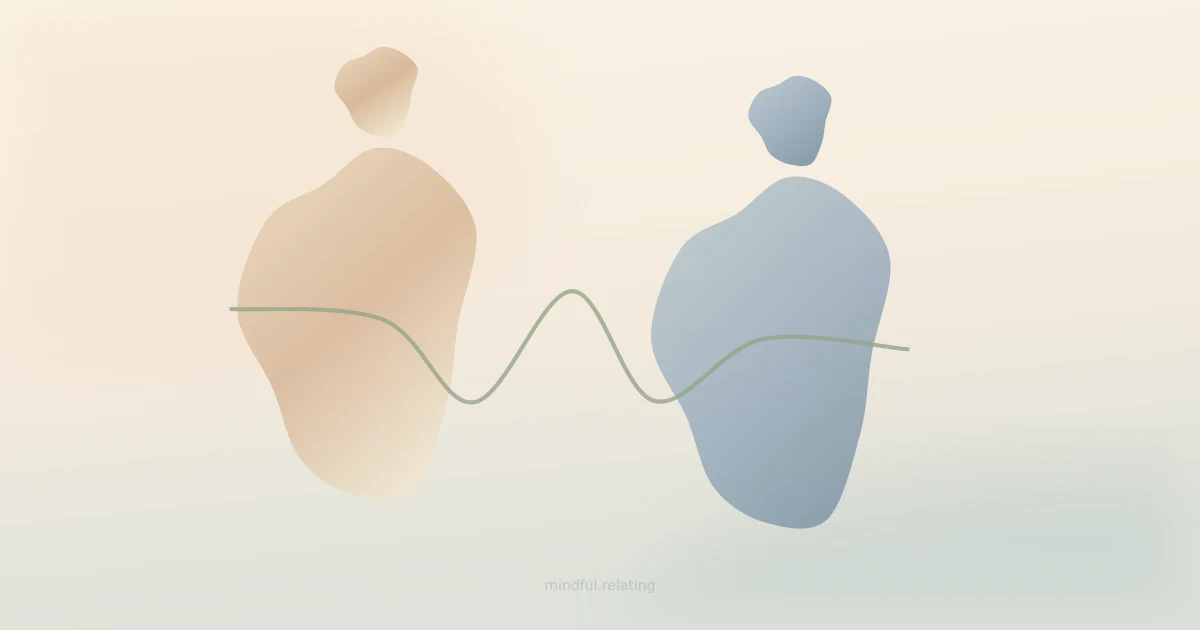
Co-regulation sounds technical, but it is ordinary human behavior. It is the way a calm voice can slow a frightened friend, or how a long exhale from someone beside you makes your own breath deepen. In a relationship, it means offering cues of safety: a softer pace, an open posture, eye contact that is not a stare, a hand offered rather than demanded.
It does not mean absorbing your partner's anger or fixing their feelings. And it is not one person being the calm one forever. Healthy co-regulation moves back and forth. Sometimes you steady them, sometimes they steady you, and sometimes you both need a break and say so. The aim is shared steadiness, not perfect composure.
- Lower your volume slightly instead of matching theirs
- Slow your sentences and leave a pause at the end
- Soften your face and unclench your jaw and hands
- Sit down or move beside your partner instead of standing across from them
- Use a short sentence like, 'I'm here, I'm not going anywhere'
Catch the spiral early
Most spirals have a first small moment: a sigh, a clipped answer, a sudden feeling of being on trial. The earlier you notice it, the less effort it takes to change course. Pay attention to your own early signals, such as a hot face, a racing thought like 'here we go again,' or the urge to correct, explain, or leave.
You can also learn your shared pattern. Maybe one of you speeds up while the other goes quiet. Maybe you both get louder. Naming the pattern out loud, kindly and outside of conflict, gives you a way to interrupt it later without it feeling like an attack.
- Name what you feel in your body before you name what they did
- Agree on a gentle phrase like, 'I think we're spiraling, can we slow down?'
- Pick up on the first sign, not the fifth
- Talk about your pattern when things are calm, not in the middle of it
Settle first, then speak
When you notice you are flooded, the most useful move is often to settle before you say anything meaningful. Take a slower breath out than in, feel your feet on the floor, and let your shoulders drop. If you can steady yourself even by ten percent, your partner will likely feel the change.
If you are both too activated, take a real pause with a promise attached. Walking away without a word can feel like abandonment to one person and like relief to the other. Saying when you will come back makes the break feel safe. Then use the time to calm down, not to rehearse your case.
- I want to hear you, and I'm too worked up right now. Can we pause for 20 minutes and then come back?
- Take a walk, drink water, or breathe slowly rather than replaying the argument
- Return at the time you said, even if you only feel mostly calm
- Start the return with warmth: 'Thanks for coming back to this'
Bring I statements back in
Once both of you feel a little more settled, I statements become useful again. They work best when they are short, specific, and paired with a need rather than a complaint. 'I felt alone at dinner, and I'd love ten minutes of your attention tonight' is easier to answer than a list of past failures.
Then slow down and practice listening skills. Let your partner respond without rushing to fix or rebut. Reflect back what you heard, even imperfectly, and check whether you got it. If the temperature rises again, return to the body first. Mindful communication is less about never spiraling and more about getting better at finding your way back together. Many couples find a coach helpful for practicing this in real time, but the basics are simple enough to begin tonight.
- I felt distant from you today, and what would help is a few minutes to talk
- What I heard is that you felt rushed. Did I get that right?
- I care about this, and I want to understand your side too
- Can we try that again more slowly?
- I need a moment, and I want to keep going with you
Bringing It Into Daily Life
Relationship spirals are not proof that something is broken. They are what happens when two people who care about each other get overwhelmed at the same time. Co-regulation gives you a way to meet that moment with steadiness instead of better arguments. Start small: lower your voice, slow your pace, and offer one calming cue the next time tension rises. Over time, you may find that the conversation you wanted to have becomes much easier to reach, and the connection underneath it feels a little safer for both of you.